CJC-1295: An Online Reading of the GHRH Analog, Its DAC Variant, and the Pharmacokinetics Separating Them.
A journal-supplement reading of the published record on CJC-1295 — the four amino-acid substitutions, the maleimidopropionyl-lysine albumin linker, the human Phase 1 pharmacokinetics, and the 2006 Phase 2 trial that halted industry development.
CJC-1295 Peptide Overview
CJC-1295 is a synthetic 30-amino-acid analog of human growth hormone-releasing hormone (GHRH 1-29) developed by ConjuChem Biotechnologies as the lead validation compound for the Drug Affinity Complex (DAC) albumin-conjugation platform [1]. The backbone carries four engineered substitutions — D-Ala2 (resists DPP-IV cleavage), Gln8 (prevents asparagine rearrangement), Ala15 (enhances bioactivity), and Leu27 (prevents methionine oxidation) [2]. The DAC variant attaches a maleimidopropionyl-lysine moiety at position 30 that forms a covalent thioether bond with Cys34 of circulating serum albumin after subcutaneous injection, producing a peptide-albumin complex of approximately 67 kDa [1].
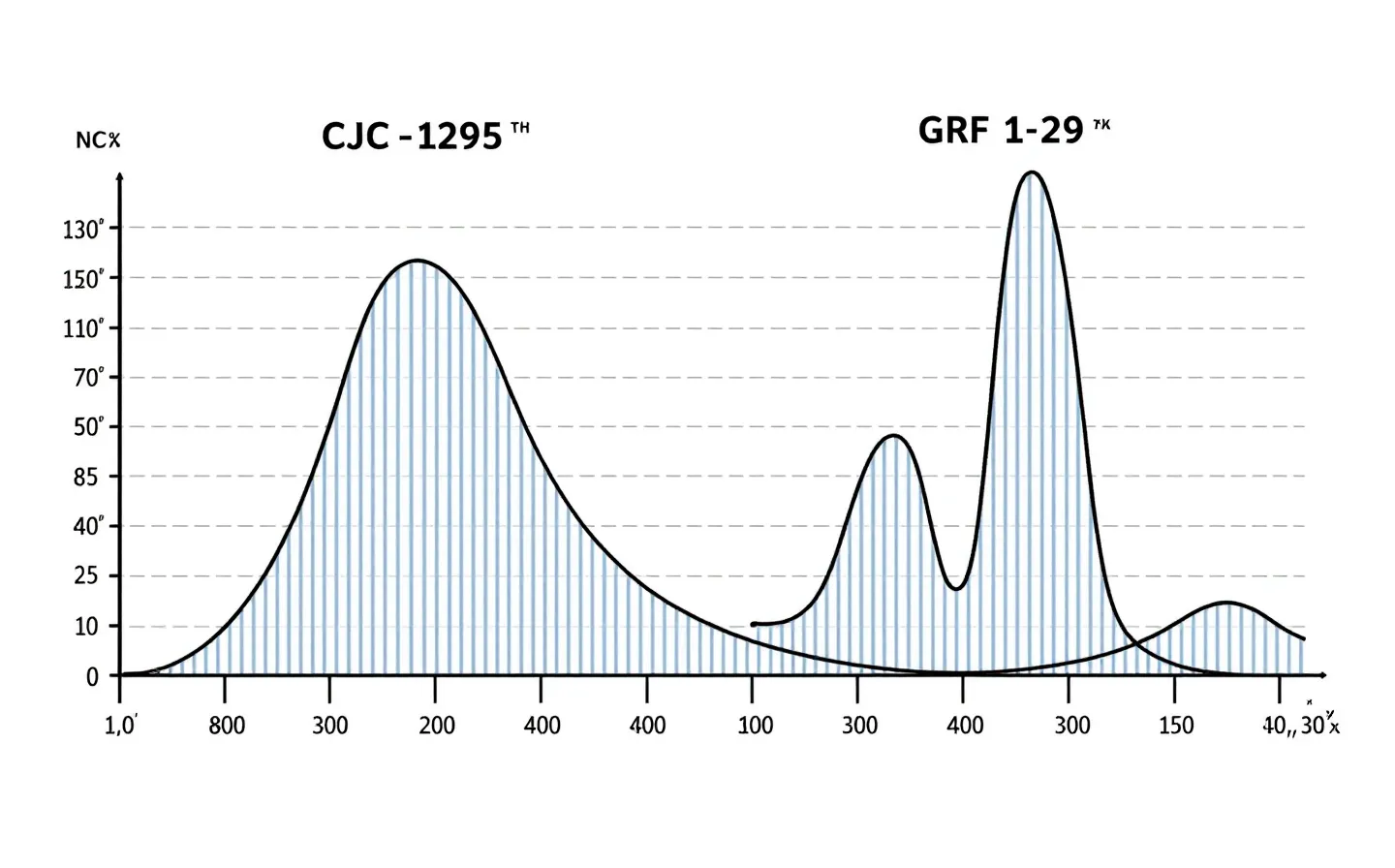
The pharmacokinetic consequence is the central editorial fact of this compound. Native GHRH 1-29 is cleared from plasma within minutes. CJC-1295 without DAC — also called modified GRF 1-29 — extends that to roughly 30 minutes. CJC-1295 with DAC extends it to between 5.8 and 8.1 days in healthy adults, with IGF-1 elevation persisting for up to 28 days under weekly or biweekly dosing [3].
What the literature has measured is a long-acting GHRH receptor agonist that preserves the pulsatile pattern of endogenous GH release even under continuous receptor stimulation [4]. What it has not produced is regulatory approval anywhere in the world. Industry development ended after a fatal adverse event in a 2006 Phase 2 trial [5]. The compound is not FDA-approved and is prohibited at all times by the World Anti-Doping Agency; FDA's page current as of April 22, 2026 records its withdrawn 503A nomination with the safety concerns intact, without explaining how pharmacies should treat the withdrawal [6][7].
What CJC-1295 does in the GH/IGF-1 axis
CJC-1295 binds GHRH receptors on anterior pituitary somatotrophs, activates Gs-protein / adenylyl cyclase / cAMP / PKA signaling, and stimulates pulsatile growth hormone release [1]. Downstream, hepatic IGF-1 production rises and remains elevated for days to weeks under the DAC variant [3].
In the first published human study, single subcutaneous doses of CJC-1295-DAC raised mean plasma GH 2- to 10-fold for six days or more and mean plasma IGF-1 1.5- to 3-fold for nine to eleven days [3]. With repeated weekly or biweekly dosing, IGF-1 remained elevated for up to 28 days. A second 2006 study under continuous receptor stimulation reported a 7.5-fold trough GH elevation, a 46% increase in mean GH, and a 45% increase in IGF-1, with pulse frequency and pulse magnitude unchanged from baseline [4]. That last finding is the mechanistic claim that distinguishes long-acting GHRH analogs from direct GH replacement — the pulsatility survives.
A preclinical complement: in GHRH knockout mice, once-daily 2 µg subcutaneous CJC-1295 for five weeks normalized body weight and length and increased pituitary GH mRNA, while dosing every 48 or 72 hours was less effective [8].
What the index covers
This online edition reads the CJC-1295 record across eight pages. The CJC-1295 mechanism of action, the CJC-1295 with DAC vs without DAC distinction, and the CJC-1295 vs ipamorelin comparison live on the research page. The CJC-1295 dosage and CJC-1295 side effects pages collect the protocol literature and the reported adverse-effect profile respectively. The frequently asked questions index gathers every question this site receives a search-volume signal on, with a direct cited answer. The references page lists every source.
This is an online edition of the record. It summarizes the peer-reviewed literature. It does not sell anything, prescribe anything, or recommend doses for humans.
What is CJC-1295?
A synthetic 30-amino-acid analog of growth hormone-releasing hormone (GHRH 1-29) carrying four amino-acid substitutions for proteolytic stability [1][2]. The DAC variant adds a maleimidopropionyl-lysine moiety that binds serum albumin and extends plasma half-life from minutes to roughly 8 days [3].
What does CJC-1295 do?
Binds GHRH receptors on anterior pituitary somatotrophs and stimulates pulsatile growth-hormone release; downstream hepatic IGF-1 rises and remains elevated for days to weeks under sustained dosing [3][4]. The compound acts on the GH/IGF-1 axis and not on the hypothalamic-pituitary-gonadal axis [3].